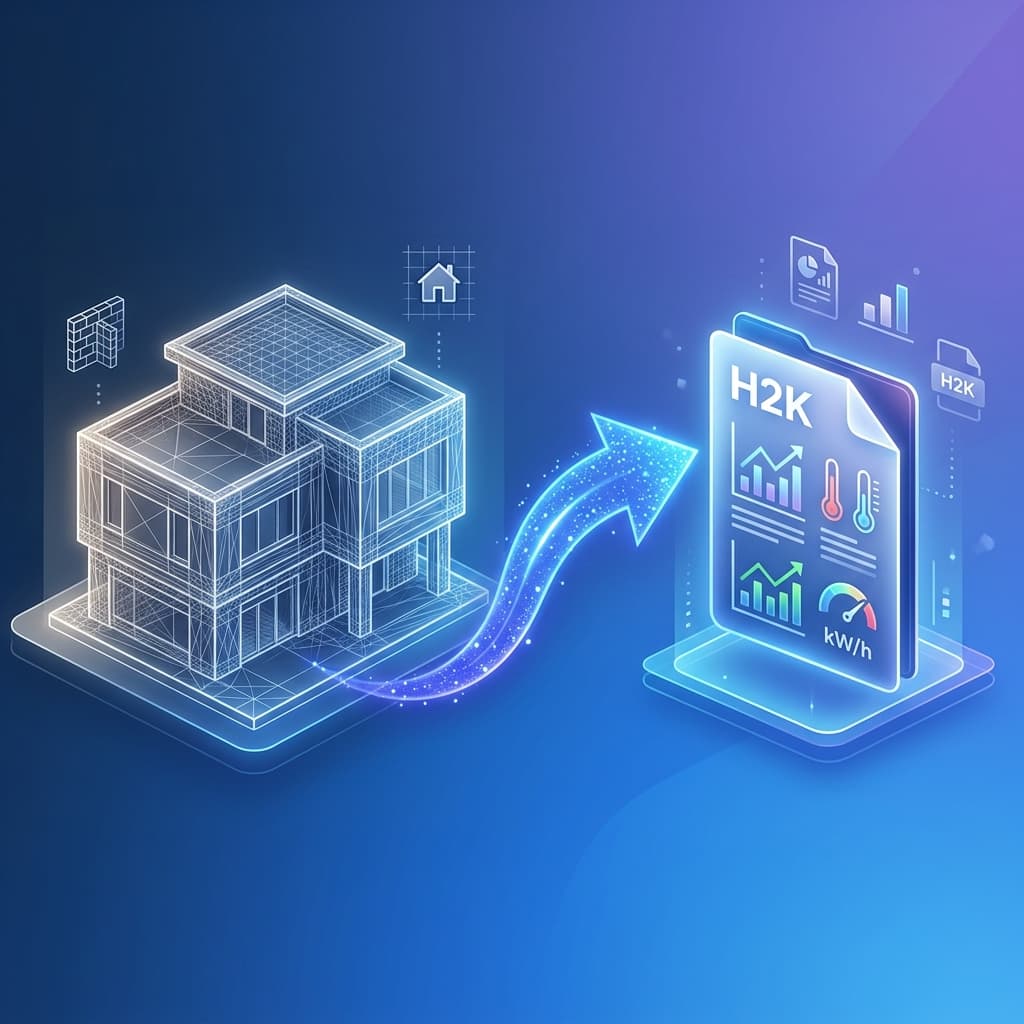
At EI Tech, we've been focused on one core problem:
How do you turn buildings into structured, machine-readable systems?
Not just visually understood — but measurable, analyzable, and actionable.
Over the past few weeks, we've made meaningful progress toward that goal.
Where We Are Today
We now have a working pipeline that can detect HVAC-related components such as:
- Baseboard heaters
- Thermostats
- Water heaters
This is powered by a custom-trained ML model built on real-world data we've been collecting.
At a surface level, this might sound like standard object detection.
But for us, detection is just the first layer.
The Real Problem
Traditional building audits are:
- Manual
- Time-consuming
- Inconsistent
- Hard to scale
Even when digitized, they often rely on human input for:
- Measurements
- Equipment classification
- System relationships
This creates a bottleneck.
If we want to move toward automated energy intelligence, we need to go beyond detection.
What We're Building Toward
The real goal is to answer three questions simultaneously:
- What is this object? (ML detection)
- Where is it in space? (spatial mapping)
- What are its physical properties? (dimensions, placement, context)
Right now, we've solved the first part.
We're actively working on combining it with the second and third using LiDAR.
The Next Step: Detection + LiDAR Fusion
Our current focus is integrating:
- ML-based object detection
- with
- LiDAR-based spatial data
The idea is simple, but powerful:
When a component is detected, we don't just label it — we anchor it into real-world coordinates and extract its dimensions.
This allows us to:
- Measure equipment automatically
- Understand placement within a room
- Build spatial relationships between systems
For example:
Instead of saying
→ "There is a baseboard heater"
We can say
→ "There is a 1.2m baseboard heater along the north wall, positioned 15cm above the floor, affecting this thermal zone"
That's a completely different level of intelligence.
Why This Matters
Energy systems are not just collections of devices.
They are spatially dependent, interconnected systems.
To optimize them, you need:
- Geometry
- Context
- Interaction mapping
This is what enables:
1. Automated Energy Audits
No manual measurement. No guesswork.
2. DER Mapping
Understanding where distributed energy resources can exist and how they interact with the building.
3. Simulation & Optimization
Running models based on real spatial and physical data.
Challenges We're Facing
This is not trivial. Some of the current challenges include:
- Aligning ML detection with LiDAR coordinate systems
- Handling occlusions and partial visibility
- Maintaining accuracy across different environments
- Hardware limitations (mobile LiDAR constraints)
We're actively experimenting with approaches to solve these — including lightweight scanning workflows and eventually dedicated hardware.
What's Next
In the near term, we're focused on:
- Improving detection accuracy across more HVAC categories
- Mapping detections into 3D space in real-time
- Extracting reliable dimensions from LiDAR data
Longer term, this becomes the foundation for:
- Fully automated building audits
- Scalable DER intelligence platforms
- Integration with next-gen demand response systems
Closing Thought
We're still early.
What we have today is not a finished product — it's a working layer in a much larger system.
But this layer matters.
Because once you can reliably connect visual understanding with spatial intelligence, you unlock a completely new way of interacting with buildings.
And that's where things start to get interesting.
More updates soon.